Meet your new data science team

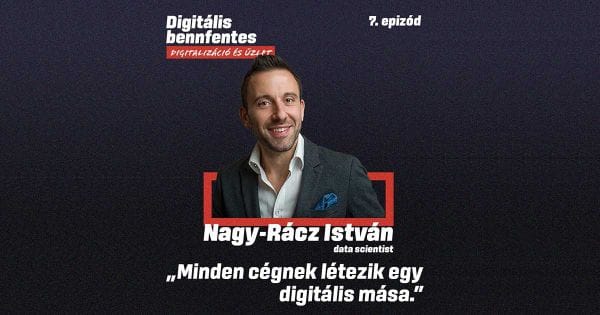
István Nagy-Rácz
CEO
Whatever the industry, the job is the same: understand what the decision-maker is really asking, and answer it with data. The rest is technique.

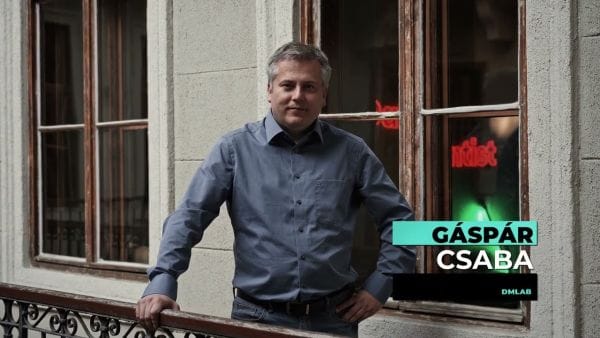
Csaba Gáspár
CEO
I started teaching data science in 2006, back when we still called it data mining. The same question has kept me going ever since: what happens when lateral thinking meets data?

Dóra Földi
data scientist

Boldizsár Gáll
office manager

Ágnes Hidi
business analyst

Dorottya Huszti
data scientist

Dániel Jónás
data scientist

Ádám Lestyán
software engineer

Péter Nagy
lead software engineer

Péter Riesz
software engineer

Gábor Törő
business developer

Márton Tremmel
software engineer

Máté Varga
software engineer

Ferenc Vargha
data engineer




“Why work with Dmlab?”
We might not be the largest, oldest, or best-known data science team – yet many clients and colleagues specifically choose to work with us. Why? Here is what they highlighted.
Data science experience building since the early days of the field
In 2001, a handwritten note in the lobby of the Budapest University of Technology and Economics (BME) announced a new data mining seminar. Ten professors applied (mostly mathematicians) – along with one of our founders, Csaba Gáspár.
Our other founder, István Nagy-Rácz, was already working on financial data science projects during his postgraduate studies in banking IT (and later during his PhD). His advisor was Csaba, who appreciated István’s market experience. Mutual respect turned into friendship, and that friendship eventually led to the founding of Dmlab.
Since then, every colleague, project, and challenge has added to Dmlab’s wealth of expertise – which you can tap into as a client or as a team member.

At one of our football games, a teammate asked me: there's this [data science] meetup, want to come?
I ended up at Dmlab because Csaba was my advisor during my Master's.
I asked my supervisor, Csaba, if he could recommend a company where they deal with data and AI stuff. Among others, he recommended his own company, Dmlab.
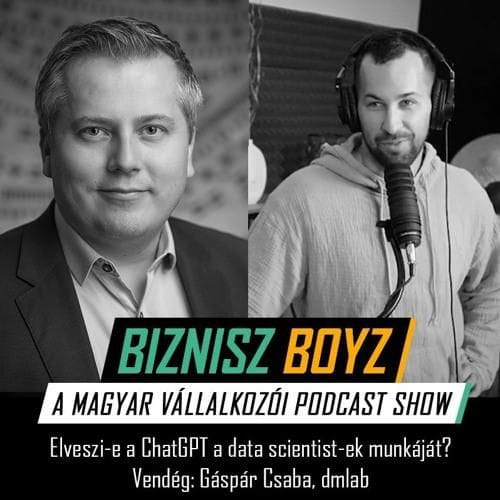
Curious about the full Dmlab story? Listen to this podcast episode:
You get the full benefit of our “out-of-the-industry” perspective
We love working with companies’ internal data science teams. They bring us on board not just for extra capacity and expertise – but for our fresh perspective.
Today, “tunnel vision” might be even more dangerous than a fierce competitor – to navigate the market you have to use the best algorithms and models, wherever they come from.

We can fall in love with absolutely any domain, even a steel mill.

You contract us to advise – we deliver business value
During development, Apple reached out to test one of our data products. We spun this project off as Radoop (later acquired by a German company, RapidMiner).
Our other spin-off, Enbrite.ly, provided a machine learning-based anti-fraud and quality control solution to the online advertising industry.
At Dmlab, the most important KPI is the generated business value.
We believe peak performance is a team sport
The more creative a data science team is, the more business value it delivers – because a creative team finds the non-obvious patterns in the data (which often turn out to be the most valuable insights).

To build such a team, Dmlab actively fosters:

An inclusive environment
Supportive team members
Diverse perspectives and experiences
(our colleagues come from many academic backgrounds: physics, economics, finance, software engineering, electrical engineering, teaching, and even baroque guitar)
The reason I like working here is it's a very good opportunity for development, and everyone’s great. I can learn new things that could be useful in the future.
What I didn't expect was that my work and private life are very much in balance here; honestly, I don't experience my work as stress, but as fun. That's why Dmlab is my best workplace so far.
We translate data into business language
Our true product is making our clients more efficient. That’s why a huge part of our job is communication: understanding the business need, translating data analysis into business outcomes, and delivering the project so clearly that even non-technical team members can use it from day one. Great data scientists are also great communicators.

Our communication experience
(outside of client work)

Bi-weekly internal training sessions led by one of our team members (so we practice communication and data science simultaneously)
In-house training
307 posts reaching 228,024 page views
Data mining (Adatbányászat) Blog
23 years (Csaba) and 19 years (István) of teaching at BME, plus dozens of corporate training programs for over 1,000 professionals
Teaching at the university and in the corporate sector
Since this is a rapidly evolving field, we often bring very novel solutions that most clients aren’t familiar with yet, so we need to be able to explain our approach, what kind of solutions we can deliver, and where this will add value for them, how they can use these.
Communication is extremely important. This might be surprising, as one might think that programmers just sit in front of a monitor, but good communication skills are crucial at both client meetings and internal discussions.
Good communication and negotiation skills are essential, especially when managing client expectations or explaining our complex solutions in a way that clients can easily present them to their own management.
The sweet spot in company size for professional data science work
Dmlab is large enough to be stable and well-established, with long-term clients, mature processes, and hybrid work.
Yet, we’ve managed to keep the charm of a smaller team: everyone knows each other by name, the culture stays personal, and there are very few meetings.
Previously, I only worked at large multinationals, where the inherent bureaucracy often caused friction. The freer atmosphere and workflow at Dmlab really appealed to me, I couldn't imagine myself going back to a huge corporation. The other thing that won me over is that here, they measure outcomes, not hours.
I really love the workplace and the community. Instead of being lost in a huge corporate machine, I'm in a more close-knit environment made up of just over a dozen people.
It's really important to me that we have the freedom to try new things. I love that we can experiment with minimal restrictions. It's great that whenever someone brings an interesting idea to the table, we actually have the opportunity to test it out.
The main focus here is to get the job done. There is no expectation to report down to the minute exactly what you were doing and when.
A company is only valuable if you’re proud to be part of it – whether as a client or an employee
We take on projects and organize our work based on what we call “extended profit”.

A project creates extended profit when it:
- is financially profitable
- benefits the client
- contributes positively to the world
- is a joy to work on
- helps us learn something new
If you think you have a data science project like this, we’d love to hear from you.
Where could you meet us?